 All posts
Where to Buy Inexpensive Moving Boxes: Cost and Strength
Discover where to find the cheapest moving boxes, how to test used cardboard for strength, and the best ways to pack and document your belongings before a move.
Corey Everett built Arclyst from a background in Library and Information Science, with the goal of bringing structured information management into everyday home life.
Gemini-assisted drafts are reviewed by Corey Everett before publication.
Publisher: EverCreate Studio
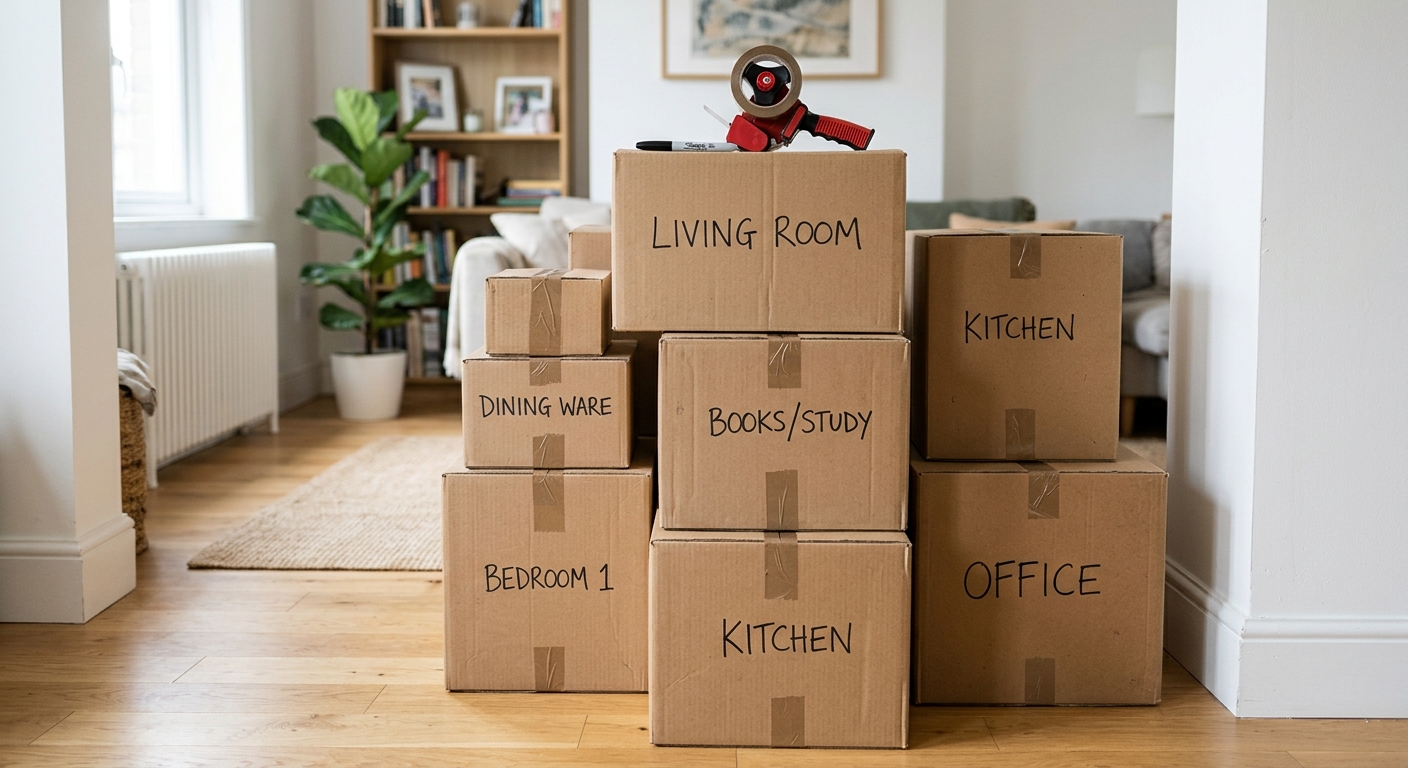
The cheapest inexpensive moving boxes come from liquor and grocery stores at $0 per box, while online bundles and big-box retailers fill the gap at roughly $1 to $3 per box when you need uniform sizes and double-wall strength.
Finding boxes is only half the battle. A free box that collapses under weight costs you far more in broken belongings than a new box would have cost at the hardware store. This guide ranks every sourcing channel by real cost per box, explains how to test a used box for structural integrity in 30 seconds, and matches box strength to fragility so your dishes survive the moving truck.
Key takeaways
- Liquor and grocery stores give away the cheapest moving boxes at $0, while online bundles and big-box retailers cost roughly $1 to $3 per box depending on size.
- A used box is safe only if it is dry, unstained, uncreased, and has carried just one load; press a corner and skip it if it folds easily.
- Single-wall boxes rated 32 ECT or 200 lb burst handle ordinary household loads; use double-wall for loads over 50 lbs, stacks taller than three boxes, or fragile items.
- Pack heavy items like books in small boxes and light items like linens in large ones, and buy about 20% more boxes than your initial estimate.
- Photograph each box's contents before sealing it and keep a numbered contents log, which helps establish proof of ownership for an insurance claim.
Where can you get inexpensive moving boxes, ranked by cost per box?
The cheapest reliable channels, roughly in order, are free local pickups, liquor and grocery stores, online bundles, and finally big-box retail. Expect free boxes to cost you time and carry some durability risk, while store bundles cost about $1 to $3 per box depending on size. Treat any per-box figure here as illustrative; prices fluctuate with location, season, and inflation.
Free local pickups: Craigslist, Facebook Marketplace, Buy Nothing
People who just finished a move usually want their empty boxes gone immediately. They frequently offload boxes by the bundle for free on community boards, Facebook Marketplace, Craigslist, or local Buy Nothing groups.
To succeed here, you must act fast and be willing to pick them up on the seller's schedule. Grab them early, but inspect them carefully. Look for tears, check for odors, and skip anything that has been rained on or stored in a damp garage. Cardboard degrades rapidly when exposed to moisture, even if it has since dried out.
Liquor stores, grocery stores, and bookstores
Retailers process massive amounts of cardboard weekly and often give away sturdy small-to-medium boxes for nothing, especially if you ask nicely on their delivery days.
Ask the produce manager for apple or wine boxes, which are typically built to handle heavy, fragile loads. However, avoid boxes that held raw meat, heavily iced produce, or anything that could leave moisture or attract pests. Bookstores are another excellent source for smaller, highly durable boxes designed to carry dense weight.
Online bundle retailers
Amazon, U-Haul online, and big-box websites sell moving kits, commonly bundling 10 to 25 boxes plus tape and markers. Buying these bundles often results in a lower per-box price than buying single boxes in-store.
The catch is shipping weight and bundle composition. Watch out for heavy shipping fees if the retailer does not offer free delivery, and check the box ratios carefully. A bundle is only a good deal if it does not force you to buy specialty sizes you will not actually use.
Big-box stores and home improvement chains
Home Depot, Lowe's, Walmart, and U-Haul sell single boxes and multipacks in-store. Small boxes often run near $1 to $2, while large or specialty boxes cost significantly more.
The upside to buying retail is consistent sizing, which makes stacking a moving truck infinitely easier, and the guarantee of clean, unused cardboard with full structural integrity. The downside is the highest per-box cost on this list. If you choose this route, comparing options like Moving Boxes from Home Depot, Moving Boxes at Walmart, or Moving Boxes From Lowe's can help you find the best local inventory.
Are free or recycled boxes actually safe to use?
Free boxes protect your belongings only when they are single-wall or double-wall corrugated cardboard that has carried just one load, stayed dry, and kept its original shape.
They fail when the cardboard has gone soft, absorbed spills, or suffered creased corners. A used box generally holds roughly the weight it held last time, but its stacking strength diminishes with every use. You must match the box to the fragility of its contents: books and towels forgive a tired box; dishes, glassware, and electronics do not.
How to inspect a used box in 30 seconds
Before you pack your valuables into a free box, perform a quick physical inspection:
- Press a corner: If the vertical corner folds or buckles without resistance, the wall structure is compromised. The box will crush when stacked.
- Check the bottom seams: Look for tape that has peeled, split, or glue that has let go. The bottom carries the entire load, so re-tape it heavily if you decide to use it.
- Sniff for moisture or food smells: Odors indicate the box absorbed something.
- Look for grease spots or water stains: Stains mean the internal paper fibers are weakened, even if the outer layer looks intact.
- Flex one flap: It should snap back with some resistance, not stay bent and limp.
Boxes you should never reuse
Some free boxes are more trouble than they are worth. Never reuse:
- Produce boxes that held ice or wet vegetables: They absorb moisture and attract pests.
- Chemical or paint boxes: Any box that held strong-smelling goods or cleaning supplies can transfer chemical residue or odors to your clothing and linens.
- Bakery boxes and flimsy liquor-store carriers: Carriers with handle cutouts are built for a short trip from the store to a car, not for being stacked in a moving truck.
- Boxes with crushed corners: Damage only gets worse when subjected to the vibrations and weight of a moving truck.
How much box strength does your stuff actually need?
What ECT and burst strength ratings mean
Two numbers appear on the bottom stamp of most moving boxes. ECT (Edge Crush Test) measures how much vertical stacking pressure the box edges can resist before buckling. Burst strength (Mullen Test) measures puncture resistance from the inside out or outside in.
A standard single-wall moving box is usually rated 32 ECT or 200 lb burst. For practical moving purposes, both ratings describe the same thing: a box that will survive one standard move, stacked a few boxes high, filled with ordinary household weight.
A fragility-to-box-strength matching guide
You should match the box construction to the fragility of the item, not just to the room it belongs in.
Books, kitchen pans, hand tools, and folded clothing do perfectly fine in standard single-wall 32 ECT boxes. Dishes, glassware, lamps, electronics, and framed pictures deserve double-wall boxes. Double-wall cardboard adds a second fluted layer, resisting edge crushing far better and absorbing more impact.
Keep in mind that anything already fragile before packing—like a mirror, a monitor, or delicate ceramics—needs proper cushioning (bubble wrap, packing paper) on all six sides. The box rating protects against stacking weight and external crushing, not against the item rattling around inside from a hard knock.
When double-wall boxes are worth the extra cost
Double-wall boxes (often rated 44 ECT or 48 ECT) earn their higher price tag in three specific scenarios:
- High stacking: Boxes you plan to stack more than three high in a storage unit or moving truck.
- Heavy loads: Any box carrying a concentrated load over roughly 50 lbs.
- High-value breakables: Anything you would hate to replace or that would require complex insurance documentation to claim.
What size boxes should you buy, and how many?
Standard box sizes and what belongs in each
Most moving boxes come in four standard sizes. The golden rule of packing is: heavy stuff goes in small boxes, light stuff goes in large ones. A large box filled entirely with books will likely blow out its bottom on the porch or injure whoever tries to lift it.
- Small (approx. 1.5 cu ft): Handles books, tools, canned goods, and records—things that get heavy very fast.
- Medium (approx. 3.0 cu ft): The workhorse size. Fits kitchen appliances, pots, pans, toys, and electronics.
- Large (approx. 4.5 cu ft): Reserved for bulky, lightweight items like linens, lampshades, board games, and pillows.
- Specialty (Dish packs, wardrobe boxes): Dish packs have extra-thick walls for kitchenware. Wardrobe boxes feature a hanging bar. Skip the expensive wardrobe box unless you have formal clothes, suits, or delicate dresses that cannot be folded.
A rough box-count estimate by apartment or house size
Every home is different, but you can use these rough averages to start your list:
- Studio or one-bedroom: 15–25 boxes.
- Two to three bedrooms: 35–60 boxes.
- Four-plus bedrooms: 70–100+ boxes.
Always buy about 20% more boxes than your initial estimate. Clean, unused boxes are usually easy to return to a big-box store, but running out of boxes at 10:00 PM the night before the movers arrive is a packing disaster.
How do you keep track of what went into each box?
Numbered boxes plus a simple contents log
The most effective way to track your move is to give every box a unique number in thick permanent marker on at least two sides. Then, keep one running list—either in a notebook or a note on your phone.
For example: "Box 7: kitchen pans, utensils, cutting boards."
The number matters far more than writing the room name on the box. Writing "Kitchen" tells you nothing when you are desperately searching for the coffee maker on your first morning in the new house.
Photographing box contents as proof of ownership
Before you tape any box shut, take a moment to photograph the open box and its contents. A searchable, room-by-room visual record is what turns a pile of packed boxes into a reliable asset list if a moving truck is involved in an accident or if you need to file a claim later.
To document everything you own before a move, follow a simple workflow:
- Pack the box.
- Take a wide photo of the open box showing the items inside.
- Crucial step: Take separate, close-up photos of any valuable items, capturing their serial numbers, brand names, or physical receipts. A wide photo of a box cannot capture a hidden serial number on the back of a drill.
- Seal the box and write its designated number on the outside.
This is where a dedicated tool can save you hours. Arclyst allows you to turn those box photos into a searchable catalog. Instead of digging through an unstructured camera roll, you can search your catalog to find exactly which box holds your tools. If you want to ditch the spreadsheet, AI cataloging can help organize your photos, though you must still ensure you capture clear images of the items and their identifying details before the tape goes on.
Cheap boxes vs. affordable moving kits: which is the better deal?
What kits include beyond boxes
Moving kits bundle boxes with packing tape, bubble wrap, packing paper, and markers. Usually, the per-box price looks worse than buying loose boxes, but it saves you a separate hardware-store run for consumables.
If you were going to buy tape and bubble wrap anyway, the kit's effective cost per box drops close to individual pricing. However, if you already own packing tape and plan to use towels and t-shirts as padding, you are paying a premium for supplies you do not need.
When buying individually wins
Buying loose boxes individually wins in three specific cases:
- You are sourcing free boxes: If you get your boxes from Craigslist or grocery stores, your per-box cost is zero, and you only need to buy tape.
- Your box count is very small: If you are moving a studio apartment, a massive 50-box kit will leave you with clutter you have to dispose of.
- You need specific sizes: Kits stock boxes in fixed ratios (e.g., 10 small, 10 medium, 5 large). If you have a massive library, you need 30 small boxes and zero large ones, making individual purchasing much more efficient.
What do people get wrong when buying cheap moving boxes?
The biggest mistake people make is matching boxes to price instead of weight. A thin, single-flute box from a liquor store might hold books for a short drive across town, but it will likely crush under the vibrations of a cross-country truck ride. Always pack heavy items in small boxes to prevent the bottom from giving out.
The second mistake is skipping documentation until the truck is fully loaded. Photographing each filled box before sealing it, and organizing those photos into best home inventory categories, takes only a few extra minutes per room. Rebuilding a list of your belongings from memory after a loss is nearly impossible.
Finally, reusing grocery boxes without checking for moisture, pests, or crushed corners is a false economy. A free box that fails and shatters your dishes costs significantly more than a $2 box that holds firm.
FAQ
Where can I get free moving boxes near me?
Check liquor stores, grocery stores, and bookstores on delivery days, and ask the manager for produce or wine boxes. Craigslist, Facebook Marketplace, and local Buy Nothing groups are also strong sources, as people who just moved frequently give away their box bundles for free. Always inspect every box for tears, odors, moisture, and crushed corners before taking it home.
Are liquor store boxes strong enough for books?
Some are, but some are not. Wine boxes are built to carry heavy glass bottles, so many handle books very well. However, flimsy liquor carriers with handle cutouts are meant for a quick trip to the car, not a moving truck. Press a corner of the box; if it folds easily, skip it. Regardless of the box type, always pack books in small boxes.
How many boxes do I need for a 2-bedroom apartment?
Plan for roughly 35 to 60 boxes for a two- to three-bedroom home, and buy about 20% more than your initial estimate. Unused, clean boxes are easy to return or pass along to a neighbor, but running short on packing supplies on the final day of packing is highly stressful.
Is it cheaper to buy moving boxes online or in store?
Online bundles of 10 to 25 boxes usually cost less per box than buying singles at big-box retailers like Home Depot, Lowe's, Walmart, or U-Haul, where small boxes often run $1 to $2. The tradeoff with online bundles is shipping weight costs and potentially receiving box sizes you will not use. Free store giveaways beat both options if you have the time to collect and inspect them.
What is the difference between single-wall and double-wall moving boxes?
Single-wall boxes have one corrugated flute layer, typically rated 32 ECT or 200 lb burst, and are designed to handle ordinary household loads stacked a few boxes high. Double-wall boxes add a second flute layer, resisting edge crushing far better. Use double-wall boxes for loads over roughly 50 lbs, stacks taller than three boxes, or highly fragile items like dishes and electronics.
Related guides
Want a frictionless way to catalog what you own? Try Arclyst — free for 55 items. Snap a photo, AI fills in the details.