 All posts
Moving Boxes From Lowe's: Sizes, Prices, and Packing Strategies
A practical guide to Lowe's moving boxes, including sizes, illustrative prices, quantity estimates, and how to mix purchased boxes with free alternatives.
Corey Everett built Arclyst from a background in Library and Information Science, with the goal of bringing structured information management into everyday home life.
Gemini-assisted drafts are reviewed by Corey Everett before publication.
Publisher: EverCreate Studio
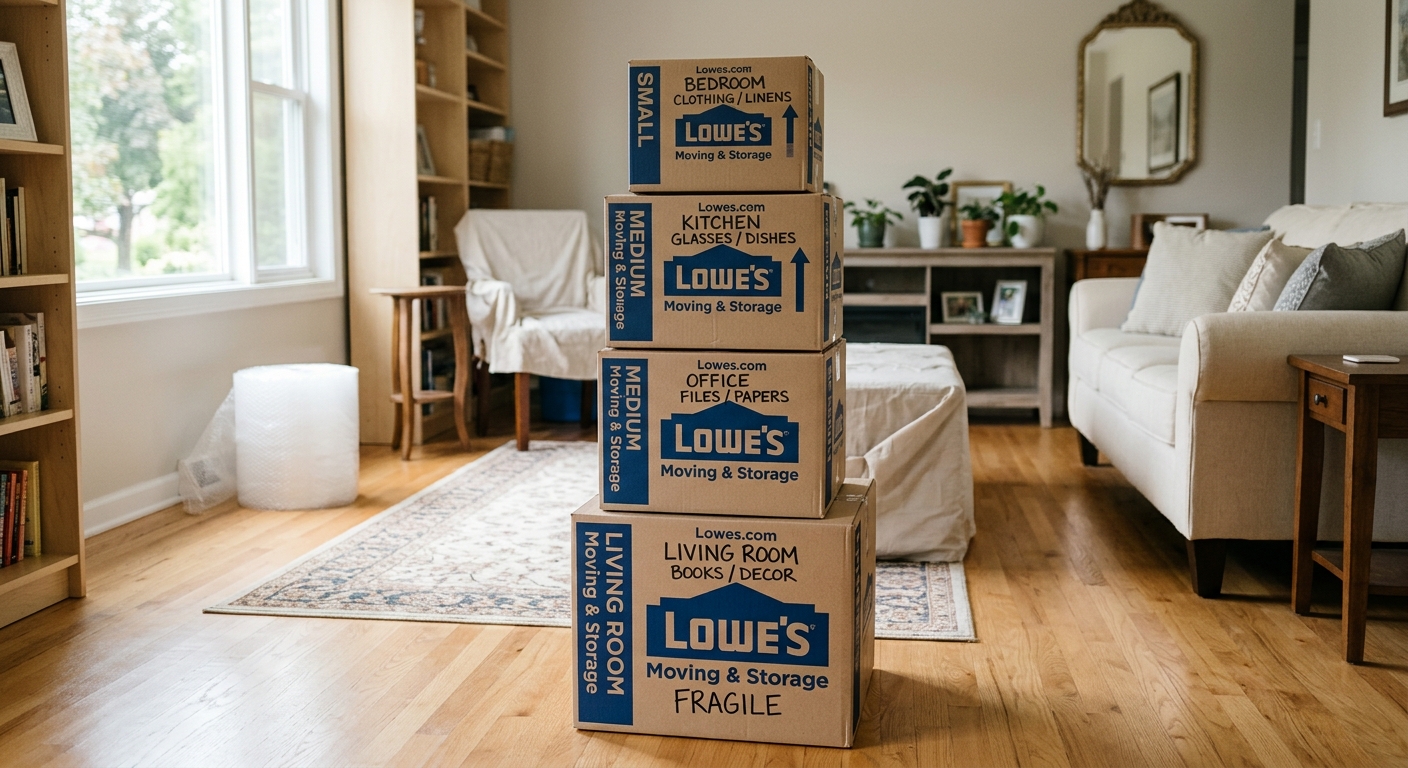
Lowe's offers a standardized lineup of moving boxes—small, medium, large, dish packs, and wardrobe boxes—designed to stack efficiently in residential moving trucks. While prices fluctuate based on regional cardboard costs, small boxes typically run $2 to $3 each, making them the most cost-effective foundation for packing a home.
Key takeaways
- Standardized sizes: Lowe's stocks small, medium, large, dish pack, and wardrobe boxes, allowing for uniform stacking and better space utilization in moving trucks.
- Quantity estimates: A typical studio move requires 15 to 25 boxes, while a three-bedroom family home generally needs 75 to 150 boxes.
- Cost-saving strategies: The most efficient packing plan mixes free, heavy-duty liquor store boxes for dense items with purchased Lowe's boxes for uniform, stackable volume.
- Weight limits: Match the box size to the item weight. Small boxes are for heavy items like books; large boxes are strictly for lightweight, bulky items like bedding.
- Documentation: Photographing box contents before sealing them helps build a searchable home inventory, though hidden serial numbers and receipts must be captured separately.
Moving requires balancing the cost of supplies against the safety of your belongings. While it is tempting to source every box for free, mismatched sizes create a chaotic, unstable load in a moving truck. This guide breaks down Lowe's moving box sizes, provides illustrative pricing, matches quantities to your home size, and explains how to document your belongings as you pack.
What sizes of moving boxes does Lowe's sell and what does each cost?
Lowe's stocks four primary box types that cover the bulk of a whole-home move: small, medium, and large standard corrugated cardboard boxes sold individually or in multipacks, plus specialty dish packs and wardrobe boxes.
Prices shift with global cardboard commodity costs and regional supply chains, so treat the figures below as illustrative. Always check your local Lowe's inventory for current pack counts and pricing before you order.
| Box Type | Typical Size | Best For | Illustrative Price |
|---|---|---|---|
| Small | ~16 x 12 x 12 in | Books, tools, pantry items, records | $2–3 each |
| Medium | ~18 x 14 x 12 in | Kitchenware, toys, folded clothes, electronics | $2–4 each |
| Large | ~24 x 18 x 18 in | Bedding, lampshades, pillows, towels | $3–5 each |
| Dish pack | ~18 x 18 x 24 in | Fragile dishes, glassware, small appliances | $5–8 each |
| Wardrobe | ~24 x 24 x 40 in | Hanging clothes, tall awkward items | $10–15 each |
Small and medium boxes: the workhorses
Small and medium boxes do the heavy lifting in any move. Because of their manageable dimensions, they fill up quickly, remain liftable for the average person, and stack neatly without crushing the boxes beneath them.
When purchasing supplies, buy more of these two sizes than you think you need. They are the cheapest per box, the easiest to carry up and down stairs, and the most versatile for organizing a moving inventory.
Large boxes and where they stop making sense
Large boxes tempt packers to consolidate too much into a single container. Filled with books, files, or dense kitchen gear, a large box will easily exceed 50 pounds. At that weight, the single-walled corrugated cardboard is prone to tearing at the handles or bursting at the bottom seams during transit.
Reserve large boxes strictly for light, bulky items. They are ideal for comforters, pillows, winter coats, and awkwardly shaped lightweight decor. If you cannot easily lift the box with one hand when it is empty, you should not fill it with heavy items.
Specialty boxes: dish packs and wardrobe boxes
Specialty boxes cost significantly more than standard sizes because they are engineered for specific tasks.
Dish packs utilize thicker, double-walled corrugated cardboard. This extra layer absorbs the vibrations and impacts of a moving truck, preventing plates and glasses from shattering. Wardrobe boxes feature a metal hanging bar, allowing you to transfer clothes directly from your closet rod to the box without folding, saving hours of packing and potential dry-cleaning bills.
Because both cost several times the price of a medium box, buy them strategically: allocate one dish pack per standard kitchen cabinet of breakables, and one wardrobe box per standard closet rod.
How many boxes do you actually need for a studio, one-bedroom, or family move?
Estimating box counts is notoriously difficult because square footage does not always correlate with the volume of possessions. However, standard industry baselines provide a helpful starting point.
Estimating by home size
- Studio apartment: Usually requires 15 to 25 boxes. This typically breaks down to a few small boxes for books and heavy items, 10 to 15 medium boxes for clothes and general goods, and one or two large boxes for bedding.
- One-bedroom apartment: Typically needs 30 to 50 boxes, depending on the size of the kitchen and the presence of a storage unit.
- Three-bedroom family home: Generally runs 75 to 150 boxes. Kitchens, garages, and basement storage areas are usually where box counts blow past initial estimates.
The decluttering adjustment
Two adjustments heavily influence your final box count. First, if you have not aggressively decluttered before packing, add roughly 20 percent to any baseline estimate. People consistently underestimate how much fits into a single box, especially when dealing with awkwardly shaped items that leave empty air gaps.
Second, consider your documentation strategy. If you plan to photograph box contents as you seal them to build a home inventory, relying on a higher volume of smaller boxes makes the process easier. A camera roll of 40 well-organized small boxes is much easier to categorize later than 20 massive, jumbled boxes containing items from three different rooms.
Which Lowe's boxes are worth it for heavy items like books and kitchen gear?
Heavy contents punish the wrong box choice. Matching the box to the weight—rather than the volume—is the most critical rule of packing.
Books, tools, and canned goods: go small
Lowe's small boxes (measuring roughly 16 x 12 x 12 inches) are the correct choice for dense, heavy items like books, hand tools, vinyl records, and canned pantry staples.
Small boxes naturally limit how much weight you can pack inside. They stay safely liftable when full, reducing the risk of personal injury. Furthermore, if a small box does fail, the damage is contained to a smaller batch of items. They also form a dense, stable base layer when loading the moving truck.
Kitchen and fragile gear: dish packs earn their price
Dish pack boxes (roughly 18 x 18 x 28 inches) are built specifically to protect fragile items. The double-walled construction resists crushing when other boxes are stacked on top of them.
While they are more expensive, the cost of a single dish pack is generally lower than the replacement cost of a shattered set of dinnerware. If a dish pack arrives damaged from shipping, Lowe's return policy typically covers replacement, so inspect them upon delivery or pickup.
Are Lowe's moving box kits cheaper than buying boxes individually?
Usually, yes. Lowe's sells bundled kits—such as small-home or medium-home moving kits—that price out slightly lower per box than buying the exact same mix individually.
However, the discount is typically modest. The real question is whether the kit's specific ratio of small, medium, and large boxes matches what you actually own.
Buy the kit when your move matches its profile. A studio or one-bedroom kit works well if you have a standard mix of clothing, kitchenware, and books. Kits offer the best value when they include specialty items like dish packs, wardrobe boxes, or packing paper that you would otherwise have to buy at full retail price.
Buy individually when your home's inventory is lopsided. For example, a book-heavy apartment needs a massive surplus of small boxes. Buying a kit padded with large boxes means you are paying for volume you cannot safely use. You can also compare these options against moving boxes from Home Depot to see which retailer's kit best fits your specific inventory.
Where can you get moving boxes for free to cut your Lowe's order down?
Sourcing free boxes is an excellent way to reduce your moving budget, provided you are selective about which boxes you accept.
Which stores give boxes away and when to ask
Liquor stores are widely considered the best source for free moving boxes. Their boxes are small, sturdy, often double-walled, and explicitly designed to carry heavy glass bottles. This makes them ideal for packing books, canned food, and heavy tools. The best time to ask is mid-week, mid-morning—after new stock has arrived and been shelved, but before the cardboard recycling has been picked up.
Grocery stores are another option, but require caution. Produce boxes are often exposed to moisture, food residue, or pests. Always inspect grocery boxes carefully before bringing them into your home.
Community groups and post-move giveaways
Buy Nothing groups and neighborhood community pages on Facebook are the fastest route to acquiring boxes in bulk. People who have just finished moving often post large stacks of broken-down boxes for free curbside pickup.
Lowe's itself sometimes clears out lightly damaged or returned boxes near the loading area, though this is highly dependent on the store manager. It is worth asking at the customer service desk rather than assuming they are available.
Strategic mixing: the 80/20 rule
A realistic haul from two weeks of casual asking is about 10 to 15 usable free boxes. Anything beyond that tends to result in highly mismatched sizes that waste critical space in the moving truck.
The most efficient strategy is to use your 10 to 15 free liquor-store boxes for heavy, awkward items, and spend your Lowe's budget on uniform medium and large boxes. Uniform boxes stack cleanly, maximize vertical space in the truck, and protect your belongings from shifting during transit.
What should you buy at Lowe's besides boxes to pack a whole home?
Boxes are only the foundation of a moving order. To pack a home securely, you need the right supporting supplies. A standard one-trip list for a one-bedroom apartment includes:
- Heavy-duty packing tape: Three rolls (roughly $5 each). Do not use masking tape or duct tape, which do not adhere well to cardboard.
- Tape gun dispenser: A quality dispenser (about $15) saves hours of frustration and lost tape edges.
- Packing paper: One 10 lb bundle (around $15) for wrapping standard kitchenware and filling empty voids in boxes.
- Bubble wrap: A 12-inch by 100-foot roll (roughly $20) for highly fragile items.
- Tools: A safety box cutter and two thick permanent markers.
Expect to spend an additional $70 to $90 on these essential supplies.
A note on USPS boxes: The United States Postal Service provides free Priority Mail boxes, but federal regulations strictly prohibit using these boxes for anything other than sending items via Priority Mail. You cannot legally use them as general packing boxes for a moving truck. However, if you are actually shipping heavy items (like books) to your new address via USPS Media Mail or Priority Mail, you can utilize their specific shipping boxes for that exact purpose.
How do you label and document boxes so nothing gets lost in the move?
Packing is only half the battle; unpacking and tracking your belongings is where most moves descend into chaos. Proper labeling and documentation protect your sanity and your assets.
Label for the unpack, not the truck
Write the destination room on two sides and the top of every box, along with a specific one-line contents note. For example, write "Kitchen: Stand mixer + baking utensils" rather than just "Kitchen Misc."
Avoid relying solely on a numbering system (e.g., "Box 14 of 60"). Numbered boxes only work if you maintain a flawless master spreadsheet, which is easily lost or abandoned during the stress of moving week.
Photograph each box before you tape it shut
Before sealing a box, lay the items out clearly and take a wide-shot photograph of the contents. This visual record serves two purposes: it helps you remember what is in each box, and it establishes a baseline record of your belongings.
If you are documenting items for insurance purposes, remember that a wide shot is not enough. You must take separate, close-up photos of hidden serial numbers, manufacturer tags, and any associated receipts, as insurers require specific details. You can learn more about this process in our guide to the home inventory photo system.
Organizing hundreds of packing photos on a standard smartphone camera roll quickly becomes unmanageable. Purpose-built tools help structure this data. Arclyst allows you to upload these packing photos and automatically extracts the visual data to build a searchable, room-by-room catalog. By capturing your items as they go into the boxes, the move itself generates your baseline inventory, helping you prepare for future insurance claims without manual data entry.
FAQ
Does Lowe's sell moving boxes in store?
Yes. Lowe's stocks small, medium, and large corrugated cardboard boxes, as well as specialty dish packs and wardrobe boxes, both in-store and online. Inventory fluctuates, so check availability at your local store before making a trip.
How much do moving boxes cost at Lowe's?
Prices vary based on regional cardboard costs, but illustrative figures run $2 to $3 for small boxes, $2 to $4 for medium, and $3 to $5 for large boxes. Specialty dish packs generally cost $5 to $8, and wardrobe boxes run $10 to $15.
Can you get free moving boxes at Lowe's?
Generally, no. Lowe's is a retail hardware store that sells boxes. However, store managers occasionally clear out damaged or returned boxes near the loading area. For reliable free boxes, check local liquor stores or community Buy Nothing groups.
What size moving box is best for books?
Small boxes (roughly 16 x 12 x 12 inches) are the best choice for books. Books are incredibly dense, and packing them in medium or large boxes will quickly exceed safe lifting weights and cause the cardboard to tear.
Are moving box kits worth it?
Kits are worth it if the included mix of sizes accurately reflects your belongings. They offer a modest per-box discount. However, if you have a disproportionate amount of heavy items (requiring small boxes) or bulky items (requiring large boxes), buying individually is more cost-effective.
Can I use free USPS boxes for my move?
By federal law, free USPS Priority Mail boxes can only be used if you are paying for Priority Mail postage to ship those specific boxes. You cannot legally use them as free packing containers for a residential moving truck.
Documenting your belongings during a move is the easiest way to build a reliable home inventory. Learn more about how Arclyst turns your packing photos into a searchable catalog by exploring our AI home inventory features.
Related guides
Want a frictionless way to catalog what you own? Try Arclyst — free for 55 items. Snap a photo, AI fills in the details.