 All posts
Moving Boxes from Home Depot: Sizes, Weight Rules, and Packing Strategies
Match every Home Depot moving box size to the right room, learn the 40-pound rule, and discover how to photograph each box to build a home inventory.
Corey Everett built Arclyst from a background in Library and Information Science, with the goal of bringing structured information management into everyday home life.
Gemini-assisted drafts are reviewed by Corey Everett before publication.
Publisher: EverCreate Studio
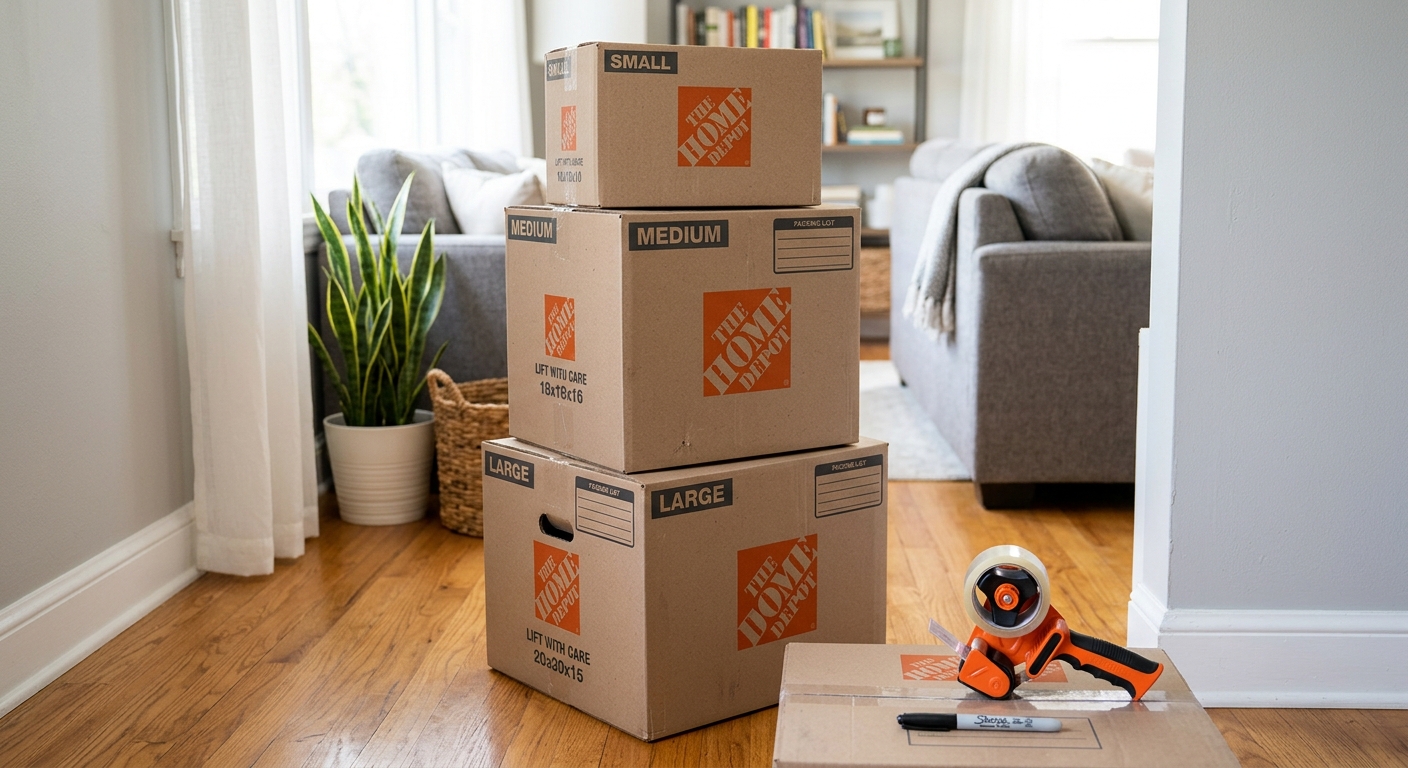
When preparing for a move, matching the right items to the correct Home Depot moving box sizes prevents crushed belongings and blown-out cardboard seams. The fundamental rule of packing is to use small boxes for dense, heavy items like books and tools, and large boxes exclusively for bulky, lightweight items like pillows and linens. Keeping every box under roughly 40 pounds ensures it remains safe to lift and structurally sound during transit.
This guide breaks down standard and heavy-duty box sizes, explains the 40-pound weight rule, and outlines a method for photographing your boxes as you pack to create a searchable record of your belongings.
Key takeaways
- Match size to density: Use small boxes for heavy, dense items (books, canned goods) and large boxes for light, bulky items (bedding, lampshades).
- Observe the 40-pound rule: Keep every box under 40 to 50 pounds to prevent bottom seams from splitting and to ensure safe lifting.
- Upgrade for fragile or heavy loads: Heavy-duty, double-wall boxes are generally worth the premium for dense items, fragile dishes, or long-distance moves where boxes will be stacked high.
- Buy extra and return the rest: Home Depot typically accepts returns on unused, flattened boxes, making it safer to over-buy by 10 to 20 percent rather than running out mid-pack.
- Document before sealing: Photograph the contents of each box before taping it shut to create a visual record for your home inventory and potential insurance needs.
Which Home Depot moving box sizes come in small, medium, and large?
Home Depot sells three core moving box sizes, each designed for specific types of household goods. While exact dimensions can occasionally vary by region or supplier, the standard sizes are small (16" x 12" x 12"), medium (18" x 14" x 12"), and large (24" x 18" x 24").
Small boxes: books, tools, and pantry items
Small boxes are designed for your densest belongings. A 16" x 12" x 12" box filled entirely with hardcover books, magazines, or canned goods will hit its practical weight limit very quickly. Tools, heavy spices, small kitchen appliances, and bathroom toiletries all belong in small boxes. By restricting heavy items to small volumes, you naturally prevent the box from becoming too heavy for a single person to carry safely.
Medium boxes: kitchenware, electronics, and toys
Medium boxes are the workhorse size for most residential moves. They offer enough volume to pack a kitchen cabinet's worth of wrapped pots, pans, and plastic containers without becoming a two-person lift. Medium boxes are also ideal for small consumer electronics, folded clothing, shoes, and children's toys. When packing medium boxes, ensure you fill empty spaces with packing paper or bubble wrap to prevent items from shifting and crushing against each other.
Large boxes: linens, pillows, and lamp shades
Large boxes offer roughly 4 cubic feet of space and are strictly for bulky, low-density items. Bedding, pillows, throw blankets, winter coats, and lamp shades belong here. Attempting to pack a large box with books or dishes will almost certainly result in the bottom giving out when lifted, or the box becoming too heavy to move safely.
| Box Size | Dimensions | Best Packed With |
|---|---|---|
| Small | 16" x 12" x 12" | Books, tools, canned goods, heavy small appliances |
| Medium | 18" x 14" x 12" | Pots, pans, electronics, shoes, toys, folded clothes |
| Large | 24" x 18" x 24" | Linens, pillows, lamp shades, winter coats, bulky plastics |
What should you never pack in a large Home Depot moving box?
The 40-to-50-pound rule
The practical weight ceiling for a standard moving box is 40 to 50 pounds. Past this point, the physics of corrugated cardboard begin to work against you. The bottom seams will flex, the packing tape will creep or tear, and the box is likely to fail when you lift it—not when you pack it.
A simple field test: if you cannot comfortably carry a box up a flight of stairs without the cardboard straining or your grip slipping, the box is too heavy.
Heavy items that destroy large boxes
Never put books, record collections, stacks of dishes, canned food, hand tools, or heavy electronics in a large box. These items keep each lift under the weight limit only when confined to small boxes.
Dishes and glassware also require the stiffer walls and cellular dividers of a specialty dish-pack or glass-pack box, rather than a large standard box where they can shift and collide. Reserve large boxes exclusively for items that take up significant space but add very little weight.
How do Home Depot's heavy-duty boxes compare to standard boxes?
Home Depot offers both standard and heavy-duty moving boxes. Heavy-duty boxes earn their premium price when the contents are dense, fragile, or when the boxes will be stacked high in a moving truck for a long-distance trip.
Double-wall construction and crush resistance
Heavy-duty boxes are manufactured with double walls of corrugated cardboard. This extra layer significantly increases the box's resistance to crushing when stacked under other heavy boxes in a truck or a storage unit.
This stacking strength is often measured by the Edge Crush Test (ECT) rating, a standard developed by ASTM International, which is typically printed on the bottom flap of the box. For protecting fragile dishes or preventing a tower of book boxes from collapsing in transit, a high ECT rating matters more than the box's cubic volume. Standard boxes handle the same items adequately for a short, local move, provided you keep the weight down and do not stack them deeply.
Where standard boxes are enough
Items that are not fragile and do not bear heavy loads do not require double-wall construction. You can safely purchase standard boxes for linens, pillows, lampshades, clothing, and lightweight pantry goods. Save your budget by spending the premium on a few heavy-duty boxes specifically for your book cartons, kitchenware, and garage tools.
Which Home Depot boxes have handles, and why does that matter?
Most standard Home Depot moving boxes are manufactured without handles to maximize structural integrity and minimize cost. However, some small and medium heavy-duty boxes feature cut-out grips punched into the side walls.
Cut-out versus molded handles
Cut-out handles are die-stamped holes in the cardboard. While they do not add extra material cost, they concentrate the weight of the box on a narrow edge of cardboard. If a medium box is fully loaded with heavy items, these cut-outs can dig uncomfortably into your fingers and, on thinner cardboard stock, tear upward.
Some specialty boxes or premium brands use molded plastic handles riveted to the wall, which spread the load across a wider patch of cardboard. These are more comfortable and less likely to fail, but they cost more and slightly reduce the usable interior space.
When to pay extra for handles
Handled boxes are worth seeking out for anything you will carry repeatedly or maneuver up and down stairs. Books, kitchenware, tools, and garage gear are prime candidates.
Skip handles for boxes containing linens, lamps, and clothes. For these lightweight items, a plain box works perfectly fine, and a handle adds unnecessary cost or structural weakness without providing a meaningful ergonomic benefit.
Should you buy individual boxes or a Home Depot moving kit?
Home Depot sells boxes individually and in bundled moving kits. Buying individual boxes is ideal if you have a specific, lopsided packing need. Buying a kit makes sense when you want to grab a full apartment's worth of supplies in a single trip and prefer the convenience of a pre-selected assortment.
What moving kits actually include
Moving kits bundle small, medium, and large boxes in preset counts, alongside packing tape, bubble wrap, and sometimes markers. These kits are usually marketed toward an apartment size (e.g., "1-2 Bedroom Kit") rather than a specific room count.
This approach works well if your belongings match the average household. However, it fails if you own a massive library of books (kits often skew toward medium and large boxes, while books require small boxes) or if you have a minimalist wardrobe but a heavily equipped kitchen. Before committing to a kit, review the exact breakdown of box sizes, not just the total box count.
When buying single boxes wins
Buying singles is the better strategy when your move is highly specific: a studio apartment with a massive record collection, a garage full of heavy tools, or a kitchen you want packed entirely in small, heavy-duty boxes.
If you buy singles, a good rule of thumb is to calculate your estimated need and add 10 to 20 percent. Home Depot's customer service policies generally accept returns on unused, flattened boxes (always verify current return policies at your local store and keep your receipt). Over-buying slightly is the lowest-risk way to ensure you don't run out of supplies at midnight before moving day.
How many moving boxes does a studio, one-bedroom, or two-bedroom move require?
Estimating by home size
Box counts vary wildly based on lifestyle, but common planning ranges provide a helpful starting point:
- Studio apartment: 10 to 20 boxes.
- One-bedroom apartment: 20 to 35 boxes.
- Two-bedroom home: 35 to 55 boxes.
These estimates should be treated as illustrative guidelines, not guarantees. The size of your closets, the density of your kitchen, and how many years you have lived in the space will swing the final box count much more than the raw square footage of the home.
Buying extra and returning unused boxes
As mentioned, under-buying boxes is a common mistake that forces an emergency store trip mid-pack. If your estimate feels comfortable, add 20 percent to the total.
Because Home Depot generally accepts returns of unused boxes, over-buying is a safe strategy. Keep your receipts, flatten any leftover boxes, and return what you do not use after the move is complete.
Where in Home Depot do you find moving boxes, and can you pick up same day?
In-store aisle location
In most Home Depot locations, moving boxes are stocked in the moving and storage section, which is frequently located near the front of the store or near the customer service desk. You will usually find them alongside packing tape, bubble wrap, stretch wrap, and box cutters.
Stock can run thin at the end of the month and during the peak summer moving season. If you cannot find the sizes you need, ask a floor associate, as seasonal setups sometimes shift inventory to different aisles.
Online ordering and same-day pickup
To save time, you can use the Home Depot website or app to search for "moving boxes," filter by your local store, and select "Pick up today." This confirms same-day availability before you make the drive. Large kits and bulk bundles can often be shipped free to the store within a few days if they are not currently stocked on the floor.
How do you turn sealed moving boxes into proof of ownership for insurance?
Moving is one of the few times you will handle every single item you own. This makes it the perfect opportunity to document everything you own before a move and build a home inventory for renters or homeowners insurance.
Photograph contents before sealing
The moment a box is full—but before the flaps are folded—is the best documentation opportunity you will get. Stand the open box where the camera can see inside, or lay the items out briefly before packing them.
Take one wide photo of the box's contents. Then, take close-up photos of anything valuable. A sealed box photographed later proves nothing to an insurance adjuster; you must take these photos before applying the tape.
Documenting serial numbers and receipts
Here is where many people misunderstand insurance documentation: a photo of a taped box labeled "Living Room" is just a photo of cardboard. Actual cash value vs replacement cost policies require proof of what the item was, its condition, and ideally its make and model.
For high-value items like electronics or power tools, you must capture the hidden details. Pull the item out, photograph the manufacturer's label or serial number, and capture any paper receipts or warranties you are packing with it. Serials and warranties are what separate a quickly paid claim from a heavily disputed one. If you have lost the receipt, a clear photo of the item and its serial number is your next best proof of ownership.
Label with room and specific contents
Writing "Box 12" on the side tells an insurance adjuster nothing, and it tells you even less when you are trying to unpack.
Write the destination room plus a specific contents line: "Kitchen: Stand mixer + baking cookbooks." This label becomes your searchable text later. Write the exact words you would naturally type when looking for the item in the future.
Using Arclyst to organize your moving photos
Managing hundreds of photos of open boxes on your camera roll quickly becomes chaotic. This is where a dedicated AI home inventory tool like Arclyst is useful.
By using the home inventory photo system—taking a wide shot of the box contents, close-ups of serial numbers, and logging the room destination—Arclyst can help turn those photos into a searchable, room-by-room catalog. This ensures that your moving boxes double as a structured insurance record, rather than just a pile of mystery cardboard.
FAQ
Does Home Depot sell moving boxes in store?
Yes. Most Home Depot stores stock moving boxes in a dedicated moving and storage section, typically near the front of the store. You can check local inventory using their website and select same-day pickup to ensure they have the sizes you need before arriving.
What size moving box is best for books?
The small box (typically 16" x 12" x 12") is the best size for books. Books are incredibly dense, and packing them in a medium or large box will quickly exceed a safe lifting weight, potentially causing the bottom of the box to break out. Heavy-duty small boxes are recommended for large book collections.
Can you return unused moving boxes to Home Depot?
Yes, Home Depot generally accepts returns on unused, flattened moving boxes, subject to their standard return policy. Keep your receipt and return the clean, unused boxes after your move. Because of this policy, it is safer to over-buy boxes by 10 to 20 percent rather than running out while packing.
How many boxes do I need to move a one-bedroom apartment?
A common planning range for a one-bedroom apartment is 20 to 35 boxes. This should include a mix of small boxes for heavy items (books, dishes) and large boxes for bulky items (linens, pillows). Your actual count will depend heavily on the size of your kitchen and the density of your closets.
Why do heavy-duty moving boxes cost more?
Heavy-duty moving boxes cost more because they feature double-wall corrugated cardboard construction. This gives them a higher Edge Crush Test (ECT) rating, meaning they are much more resistant to collapsing when heavy boxes are stacked on top of them in a moving truck or storage unit.
Related Arclyst guides
Related guides
Want a frictionless way to catalog what you own? Try Arclyst — free for 55 items. Snap a photo, AI fills in the details.