 All posts
Moving Boxes at Walmart: Costs, Sizes, and Selection
A complete guide to buying moving boxes at Walmart. Compare prices, sizes, and in-store availability against Home Depot, plus tips on packing and documenting.
Corey Everett built Arclyst from a background in Library and Information Science, with the goal of bringing structured information management into everyday home life.
Gemini-assisted drafts are reviewed by Corey Everett before publication.
Publisher: EverCreate Studio
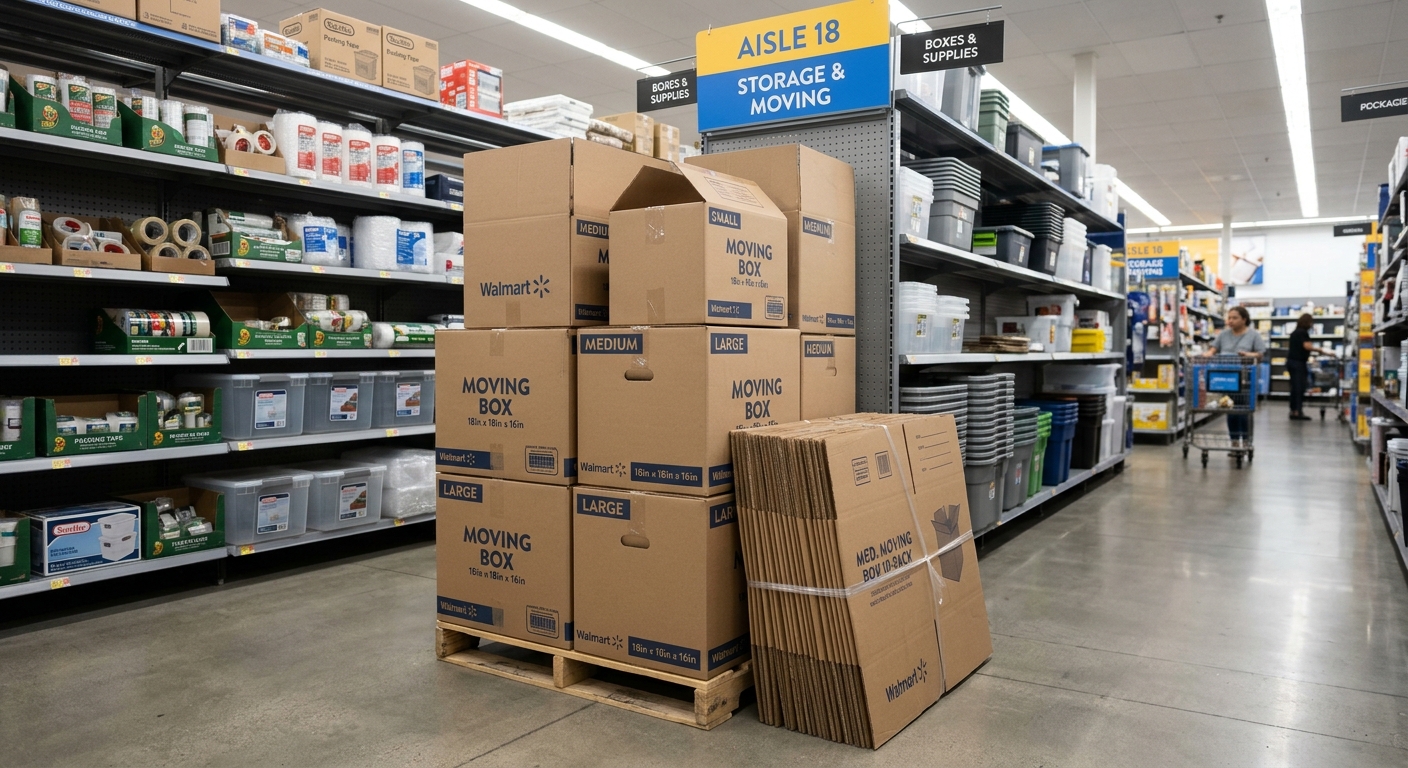
Yes, Walmart sells moving boxes in most physical stores and online. Small boxes typically cost around a dollar, while medium and large sizes range from two to three dollars. However, in-store selection is often limited to standard sizes, while specialty items like wardrobe boxes are usually relegated to their website.
If you are planning a move, knowing exactly what Walmart carries—and what it doesn't—can save you a frustrating trip. Here is a detailed breakdown of what Walmart stocks, how much their boxes cost, how they compare to competitors like Home Depot, and how to properly pack and document your belongings before the moving truck leaves.
Key takeaways
- Walmart sells moving boxes in most stores and online, with small boxes starting around $1 and large boxes ranging from $2 to $3.
- In-store selection is often thin and varies by location, so always check walmart.com for local pickup availability before driving to the store.
- Home Depot typically stocks a deeper range of heavy-duty and specialty boxes in-store, making it a better stop for large or complex moves.
- Walmart's standard boxes are single-wall corrugated cardboard, meaning you should use small boxes or reinforce the bottoms for heavy items like books.
- Photograph and label the contents of each box before sealing it to maintain a clear record of ownership for potential transit insurance claims.
Does Walmart sell moving boxes in-store or only online?
Yes, Walmart sells moving boxes in most physical stores, but the selection on the shelf is much narrower than what you will find on walmart.com. Stores typically stock a small range of cardboard box multipacks and single boxes near the stationery, office, or storage sections.
The website lists a much wider variety of sizes, multipacks, and specialty boxes (like TV boxes or dish packs), many of which ship directly to your door rather than to the store. Because physical shelf space is limited, availability varies significantly by location. Always check your local store's inventory before making a dedicated trip.
How to check in-store availability on Walmart.com
To avoid an empty shelf, open any moving box listing on Walmart.com and look at the delivery and pickup block on the product page.
- If it says "Pickup" or "In stock at [your store]," your local store currently carries it.
- If it only says "Shipping," that specific box or multipack is online-only.
- You can enter your ZIP code in the store selector to check stock at other Walmart locations in your area.
What aisle moving boxes are usually in
In most Walmart locations, look for moving boxes in the office and storage supplies aisle, often positioned near packing tape, bubble wrap, and shipping envelopes. In some larger Supercenters, hardware-adjacent items like heavy-duty boxes or moving blankets might be located near the automotive or hardware departments. Occasionally, they are placed in seasonal aisles during peak summer moving months.
How much do moving boxes at Walmart cost per box size?
Walmart is generally a budget-friendly option for standard moving supplies. Box prices run roughly $1 for small, $1 to $2 for medium, and $2 to $3 for large. Specialty boxes, such as wardrobe boxes with hanging bars or heavy-duty dish packs, cost more.
Note: Treat these prices as illustrative ranges rather than exact quotes. In-store pricing varies by region, and online listings fluctuate based on supply chain factors. Always check your local store's listing for current pricing.
| Box type | Typical single-box price (illustrative) | Common multipack |
|---|---|---|
| Small | ~$1 | 25-pack |
| Medium | ~$1–$2 | 15–25 pack |
| Large | ~$2–$3 | 12-pack |
| Wardrobe / specialty | ~$3+ | Usually single |
Multipack vs. single-box pricing
Buying in multipacks significantly lowers the per-box cost. A 25-pack of small boxes can bring the unit price down to roughly $0.60 to $0.80 per box, compared to a full dollar or more when purchased individually.
If you are packing a whole apartment, buy the multipacks and skip singles entirely. Single boxes only make financial sense when you are at the very end of your packing process and need one or two odd sizes to finish a room.
Shipping fees and minimums for online box orders
Moving boxes usually qualify for free "ship to store" delivery, so ordering online and picking up at the customer service desk avoids delivery fees. Shipping directly to your door usually requires meeting a minimum order value (often around $35), which a single pack of boxes might not meet. If your local store is out of stock, the ship-to-store option is a reliable way to pull from nearby regional inventory without paying extra.
What moving box sizes does Walmart carry?
Walmart's in-store selection focuses on the three most common dimensions needed for a standard household move:
- Small boxes (approx. 16 x 12 x 12 inches): Best for heavy, dense items like books, canned goods, tools, and small heavy appliances.
- Medium boxes (approx. 18 x 14 x 12 inches): The versatile middle ground. Good for pots, pans, folded clothing, toys, and electronics.
- Large boxes (approx. 24 x 18 x 24 inches): Reserved for lightweight, bulky items like pillows, comforters, lampshades, and large plastic toys.
Wardrobe and dish-specific boxes
Wardrobe boxes (roughly 24 x 24 x 40 inches, featuring a metal hanging bar) and dish boxes (which feature double-wall construction for impact resistance) are the two specialty types most movers eventually need.
Walmart stocks these primarily online, though a few Supercenters may carry them in-store during the summer. If you need specialty boxes today, you may have better luck at a dedicated hardware store.
Weight limits and packing rules per box size
A safe, practical rule for moving boxes is to limit small boxes to about 40 pounds, medium boxes to 50 pounds, and large boxes to 60 pounds.
Never pack a large box full of books; the cardboard will tear, and the box will be too heavy to safely lift. Whatever weight you pack, ensure you capture electronics serial numbers before you seal them so you have proof of ownership for any potential insurance claims.
When should you buy moving boxes from Walmart vs. Home Depot?
Both retailers sell standard cardboard boxes at comparable prices, but their inventory strategies differ. Buy from Walmart when you are already there for groceries and need a handful of standard boxes today. Buy from Home Depot when you need volume, heavier-duty boxes, or specialty sizes in a single trip.
When Walmart wins
Walmart is the convenience play. If your local store has moving and shipping boxes on the shelf, you can grab what you need during your weekly grocery run. Prices on common small and medium sizes tend to be highly competitive. For a studio or one-bedroom move where you only need a dozen or two boxes, Walmart is usually sufficient. The tradeoff is selection: in-store stock varies, and specialty sizes are unreliable on the shelf.
When Home Depot wins
Home Depot is where you go when the packing list is long, the items are heavy, or the sizes are odd. Home Depot moving boxes typically include heavier double-wall options, heavy-duty dish packs, and wardrobe boxes right on the shelf. A two-bedroom move is often a single trip to Home Depot, whereas it might require multiple shelf checks at Walmart.
Are Walmart's shipping boxes strong enough for heavy items like books?
Most boxes sold in Walmart's moving aisle are single-wall corrugated cardboard. This material handles everyday kitchen and linen loads perfectly well but softens quickly under dense, heavy weight or high humidity.
Books, canned food, and small appliances are classic "box killers." A medium box filled with hardcovers can easily exceed 40 pounds, stressing the bottom flaps long before you even attempt to lift it. For heavy loads, you must either find double-wall boxes or reinforce standard boxes.
How to test a box before loading it
Before committing your fragile items to a box, test its structural integrity:
- The squeeze test: Press the sides inward. If the wall flexes easily or crinkles audibly, it is a light-duty box.
- The seam check: Look at the glued seam down the side of the box. Gaps indicate weaker manufacturing.
- The lift test: Fill the box halfway with your intended load, tape the bottom securely, and lift it. If the bottom sags noticeably, downgrade that box to holding pillows and towels.
Reinforcing boxes for heavier loads
If you only have single-wall boxes, reinforce the base. Run a strip of high-quality packing tape directly across the center seam, then run two more strips perpendicular to it, extending the tape at least halfway up the sides of the box. This transfers the weight from the bottom flaps to the vertical walls of the box.
How many boxes do you actually need for a move?
Estimating box counts is notoriously difficult because household density varies wildly. However, industry averages provide a solid baseline:
- Studio apartment: 15–20 boxes
- One-bedroom apartment: 25–35 boxes
- Two-bedroom home: 40–55 boxes
Book-heavy households or those with extensive kitchen equipment will run higher; minimalists will run lower. Treat these as planning estimates, not guarantees.
A buying rule that avoids mid-pack store runs
To avoid running out of boxes at 11:00 PM the night before your move, buy 70% of your estimated total before you pack anything, and keep the receipt.
If you finish early, unopened, flattened boxes can usually be returned. If you run short, you already know the per-box price and can grab the remainder on a normal shopping trip instead of making a panicked, dedicated run.
How do you document what's inside each box before the truck leaves?
A move compresses every proof-of-ownership problem into a single afternoon. Boxes get taped shut, loaded onto a truck, and mixed together. If a box is lost in transit or damaged by a leak in the truck, an insurance claim depends entirely on what you recorded before the box was sealed.
Label systems that survive the truck
Use a strict numbering system. Write one unique number per box on two sides plus the top (e.g., "Box 12"). Keep a master list that corresponds to the numbers: Box 12 = Kitchen utensils; Box 13 = Office electronics.
Use a permanent marker rather than adhesive stickers, as stickers can easily peel off in a hot moving trailer. Organizing a moving inventory checklist room by room ensures you don't lose track of which box belongs where.
Why moving day is the highest-risk window for losses
During a move, items are off shelves, out of drawers, and stacked in a vehicle. This is exactly when things break, get left behind, or vanish. A photo of a taped brown box proves nothing to an insurance adjuster. You need visual proof of the contents.
Before you tape the top flaps shut, photograph the open box showing its contents. If you use an app like Arclyst, you can document belongings before moving by photographing items room by room and logging them into a searchable catalog. This ensures that "the box with the router and serial number" is findable later.
The honest limitation of any photo-first system is that it only helps if you actually capture the items before the box is sealed. Build the photograph into your taping routine: pack, photograph, tape, label. Do not plan to "catch up later," because once the tape is on, the record is gone.
Frequently asked questions
Does Walmart sell moving boxes in the store or only online?
Both. Most physical stores stock a small range of standard cardboard multipacks near the stationery and storage aisles. Walmart.com lists a much wider variety of sizes, including specialty wardrobe and dish boxes. In-store selection varies by location, so check the product page for a pickup or in-stock note before driving over.
How much is a pack of moving boxes at Walmart?
Expect roughly $1 per small box, $1 to $2 per medium, and $2 to $3 per large. Multipacks lower the per-box cost significantly: a 25-pack of small boxes can run about $0.60 to $0.80 each, versus about $1 when bought singly. Treat these as illustrative ranges and check your local listing for current pricing.
Are Walmart moving boxes good quality for books and heavy stuff?
Most standard Walmart moving boxes are single-wall corrugated cardboard, which handles kitchen and linen loads well but softens under dense weight. A medium box of hardcovers can easily exceed 40 pounds and stress the bottom flaps. For books, use small boxes, seek out double-wall construction, or heavily reinforce the base with packing tape.
Does Home Depot have cheaper moving boxes than Walmart?
Per-box prices are generally comparable between the two retailers. However, Home Depot usually stocks a wider range in-store, including heavier double-wall options and specialty sizes like wardrobe and dish packs. Walmart is usually faster for a short list of standard boxes, while volume moves favor Home Depot.
Where are moving boxes located in Walmart?
Most stores keep them near the office, stationery, or storage aisles, close to packing tape and shipping supplies. Some stock them in the back near automotive or hardware. If you cannot find them, ask an associate to check the item number in the Walmart app to see exactly which aisle they are located in at your specific store.
Related guides
Want a frictionless way to catalog what you own? Try Arclyst — free for 55 items. Snap a photo, AI fills in the details.