 All posts
Epiphone Guitar Serial Number Lookup: Decode Yours
Learn how to decode your Epiphone guitar's serial number to find its production year and factory, and how to document it for insurance records.
Corey Everett built Arclyst from a background in Library and Information Science, with the goal of bringing structured information management into everyday home life.
Gemini-assisted drafts are reviewed by Corey Everett before publication.
Publisher: EverCreate Studio
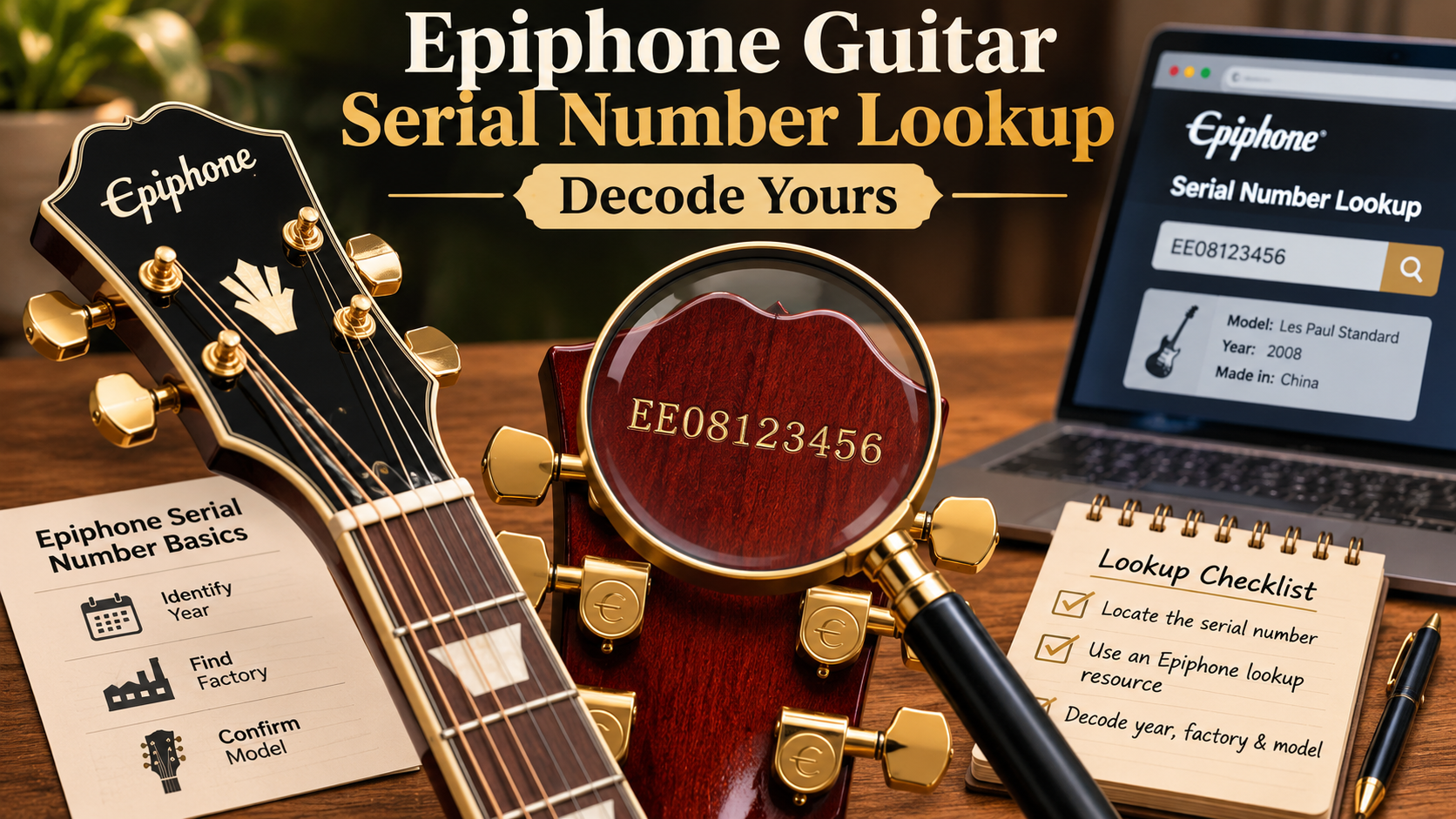
An Epiphone guitar serial number lookup tells you the factory where your instrument was built and the year it was manufactured. Depending on the era, Epiphone used specific formats like a 6-digit Japanese code, an 8-digit Korean sequence, or a dedicated letter prefix to track production. That decoded number is also one of your strongest pieces of evidence for proving ownership, provided you document it correctly.
Here is how to find your serial number, decode the factory and year, and build the photographic record and receipt trail that can help support an insurance claim if your guitar is ever lost, stolen, or damaged.
Key takeaways
- Year and factory, not model: Epiphone serial numbers decode to a production year and a specific factory, but they never decode to the exact guitar model.
- Japanese 6-digit codes: Six-digit serials from the Fujigen era read as YYMM plus a two-digit unit number.
- Korean 8-digit codes: Eight-digit serials typically follow a YYMMDD format followed by a daily unit number.
- Letter prefixes: Prefixes like F, EE, I, S, T, R, and MC identify the specific factory and era behind the digits.
- Fakes reuse real numbers: A valid serial number is not proof of authenticity, as counterfeiters frequently reuse legitimate-looking numbers on fake guitars.
- Documentation matters: Pair the decoded serial with five specific photos and purchase proof in a searchable home inventory to support an insurance claim.
Where is the serial number located on an Epiphone guitar?
Before you can decode the history of your instrument, you have to find the number. Epiphone's placement varies slightly depending on whether the instrument is acoustic or electric, and how old it is.
Headstock placement on electrics
On the vast majority of Epiphone electric models—like the Les Paul, SG, or ES-335—the serial number is located on the back of the headstock. Depending on the factory and the year, this number might be stamped directly into the wood, printed in ink, or applied as a decal.
Some newer instruments also ship with a paper certificate of authenticity that repeats this exact serial number. When documenting your instrument, photograph the headstock stamp exactly as it appears; faded ink or shallow stamping is incredibly common on older guitars and is part of the instrument's unique footprint.
Soundhole labels on acoustics
Epiphone acoustic guitars, as well as hollow-body electrics, typically carry their serial number on a paper label visible through the soundhole.
Reading this label can sometimes be difficult due to shadows or the angle of the strings. You may need to use a phone flashlight and a small inspection mirror, or carefully angle your smartphone camera through the strings to capture it. Always photograph the full label, as it usually displays the model name alongside the serial number.
When the sticker is missing or worn
Over decades of playing, ink fades, headstocks get scratched, and soundhole labels dry out and peel off. If the stamp is heavily worn or the label is missing, you can sometimes still decode the guitar's origins from partial digits, provided you know the general format for that era and factory.
Record whatever partial string you can clearly read. Then, photograph the headstock, the empty soundhole label area, and the full guitar. Even if the number is incomplete, these photos establish the condition and existence of the instrument for your ownership record. If you are dealing with a completely blank instrument, understanding how missing serial numbers impact insurance payouts can help you prepare alternative documentation.
How do you decode each Epiphone serial number format by factory and era?
Epiphone has utilized several different manufacturing facilities across Japan, Korea, and China over the decades. Because of this, there is no single "universal" Epiphone serial number format. You have to match the format of your number to the correct era.
6-digit Fujigen format (1966–2007)
Early Japanese-made Epiphones, particularly those built at the Fujigen factory, often use a straightforward six-digit number.
- First two digits: The production year.
- Second two digits: The production month.
- Last two digits: The production unit number for that specific month.
For example, a serial number reading 780542 decodes as May (05) of 1978 (78), and it was the 42nd unit built that month.
Because a two-digit year format repeats every 50 years, context is necessary. A six-digit number on a modern-style bolt-neck electric guitar is almost certainly from the 1970s to 2000s production run, not from 1928.
8-digit Korean formats: Unsung, Saein, Peerless
When Epiphone shifted significant production to Korean factories like Unsung, Saein, and Peerless, they largely standardized on an eight-digit format.
- First two digits: The year (YY).
- Second two digits: The month (MM).
- Third two digits: The day (DD).
- Last two digits: The unit number for that day.
For instance, the serial 03041562 decodes as April 15, 2003, and it was the 62nd unit produced that day. Because multiple Korean factories used variations of this exact scheme, the factory itself usually cannot be identified from the digits alone unless a letter prefix is present. If your serial is exactly eight digits with no letters, this is the first format you should test.
Qingdao and Deewon Chinese formats
Modern Chinese production uses longer codes that vary significantly by factory and era. These formats commonly bake an internal factory code directly into the sequence, and they often run 10 or more characters long.
Qingdao numbers, for example, cannot always be decoded to an exact day without internal factory documentation. For these modern guitars, it is critical to record the full string exactly as printed. A partial transcription of a 12-character Chinese serial number is often worse than no transcription at all, as it makes the number impossible to verify.
Letter-prefix codes: F, EE, I, S, T, R, MC
Many Epiphone serial numbers begin with a letter prefix. These letters are the most reliable way to identify the specific factory that built the guitar.
| Prefix | Factory & Location |
|---|---|
| F | Fujigen, Japan |
| EE | Elitist series by Terada, Japan |
| I | Iida, Japan |
| S | Saehan, Korea |
| T | Terada, Japan |
| R | Peerless, Korea |
| MC | Made in China |
These letter prefixes usually combine with digits that encode the year and unit number. However, decoding the result is only half the job. To protect your investment, you must pair that decoded serial with photos and purchase proof in a searchable home inventory entry.
What can an Epiphone serial number tell you about year, factory, and model?
A properly decoded Epiphone serial number reliably provides two pieces of information: the production year and the factory of origin. An 8-digit code starting with a two-digit year points to Korean manufacturing; letter prefixes like F or EE identify Japanese craftsmanship; and newer, longer codes trace back to Chinese facilities.
Why the serial number will not reveal the exact model
What an Epiphone serial number will not tell you is the exact model of the guitar.
Epiphone reused serial formats across many different models built in the same factory during the same year. The serial number alone cannot distinguish a high-end Les Paul Custom from an entry-level Les Paul Special. The factory simply stamped the next sequential number onto whatever neck was moving down the line that day.
The impact on insurance documentation
This limitation matters heavily for insurance documentation. Insurance carriers value the named model, not just the factory it came from.
If you only write down the serial number, an adjuster has no way to verify whether you lost a $200 beginner guitar or a $1,000 professional instrument. You must record the decoded year and factory, confirm the model name from the headstock or soundhole label, and log all of these details together in a searchable catalog so your proof of ownership matches your policy's requirements.
What are common Epiphone serial number lookup mistakes and fake-serial red flags?
The most common lookup mistakes involve misreading worn digits—confusing an 8 for a 3, or a 0 for a letter O. Another frequent error is assuming every Epiphone uses one universal format. If you try to decode an 8-digit Korean code using the 6-digit Japanese scheme, you will end up with a production year that doesn't make sense.
Red flags that a serial is fake or reused
Counterfeit guitars are a reality in the used market. Watch out for these red flags:
- Impossible dates: A serial that decodes to a year before that specific model was ever introduced.
- Unknown formats: A string of letters and numbers that matches no known Epiphone factory scheme.
- Reused numbers: The exact same serial number appearing on multiple guitars for sale online. Counterfeiters often reuse real-looking numbers because it costs them nothing to print the same decal repeatedly.
- Physical anomalies: Sloppy font kerning, uneven stamping depth, or a serial number placed on the back of a headstock where the factory historically used soundhole labels.
Why a valid serial is not proof of authenticity
A serial number identifies a production run; it does not guarantee the authenticity of the guitar in your hands. Fakes routinely copy legitimate serial numbers. A perfectly decodable number tells you nothing about the wood quality, the hardware, or the wiring inside the guitar.
To build a robust record, pair the decoded number with photos of the headstock, the label, the serial itself, and any receipts. Recording this full set of evidence makes your ownership record much harder to dispute.
What should you photograph and record alongside the serial number?
A serial number alone proves that a specific guitar was manufactured. It does not prove that the guitar belongs to you, nor does it prove what the guitar is worth.
The five photos that matter for a guitar
To create a reliable home inventory photo system, you need to capture five specific angles:
- The serial number: Shot close enough to read the digits clearly.
- The full headstock: Showing the Epiphone logo and tuner arrangement.
- The full body (front): Capturing the finish, pickguard, and overall condition.
- The full body (back): Documenting the neck joint and any buckle rash or wear.
- Hardware details: A close-up of the tuners, bridge, and pickup covers.
If your serial uses a letter prefix (F, EE, I, S, T, R, or MC), ensure it is perfectly in focus. Those prefixes mark the factory and era and are incredibly easy to misread from a blurry photo years later.
Receipts, listings, and appraisals as proof of value
Save your original purchase receipt. If you bought the guitar secondhand, save the listing email or take a screenshot of the seller's marketplace page before it gets deleted.
For high-value or vintage models, an independent appraisal gives an insurance adjuster a concrete number to work from. Store all of these documents in one centralized place. Arclyst helps people catalog belongings from photos into searchable records, allowing you to attach these receipts directly to the photos of your guitar.
How do you add a decoded guitar to a home inventory for insurance purposes?
A decoded serial number only becomes an insurance-ready entry when you pair it with a fixed set of descriptive fields.
The fields your ownership document needs
When logging your guitar, include the following:
- Make: Epiphone
- Model: (e.g., Les Paul Standard '50s)
- Serial Number: The exact string of characters.
- Decoded Year and Factory: (e.g., 2003, Saein Factory, Korea)
- Purchase Price and Date: What you paid and when.
- Location: Where you bought it (e.g., Reverb, local guitar shop).
Add your five photos, store the receipt alongside them, and note any serial-number quirks you confirmed during the lookup.
Why serial numbers change your payout
A vague insurance claim for "a black electric guitar" invites a lowball settlement based on the cheapest available replacement. A detailed claim citing the exact model, decoded year, and serial number reads as definitive proof of ownership. This level of detail supports replacement-value pricing rather than a depreciated guess.
Photo-based entry vs spreadsheet
Manual spreadsheets often stall because typing every field by hand is tedious. Photo-based inventory tools allow you to start from the headstock picture you already took, prompting you only for the essential details like the serial and price. This friction-free approach is why photo-first tools actually get finished, whereas spreadsheets are frequently abandoned halfway through the house.
How do you prove ownership of a stolen guitar without a receipt?
While a receipt is the strongest proof of value, it is not the only way to prove you owned an item.
What insurers accept as an ownership document
If you no longer have the receipt, insurers often consider alternatives. A decoded serial number written down alongside the factory and year, photos showing the serial and headstock inside your home, the original listing email from a marketplace purchase, or a credit card statement showing the payment can all prove ownership without a receipt.
The common thread across all these alternatives is that the evidence was created before the loss occurred, and it is tied directly to that specific guitar.
Building the record before you need it
After a theft or a fire, you cannot photograph a guitar you no longer have, and a serial number you never wrote down is impossible to recover. Documenting your instruments before a loss is the only reliable route.
A searchable home inventory ensures this record exists while the guitar is still safely in your hands. By taking a room-by-room approach, you can capture the headstock, the serial, and the unique wear that makes the guitar identifiable, ensuring your Epiphone is fully documented alongside the rest of your household assets.
Frequently asked questions
How do I tell what year my Epiphone was made if the serial number is only 6 digits?
For 6-digit Japanese formats, read the first two digits as the year, the next two as the month, and the last two as the unit number for that month. A serial of 780542 means May 1978, unit 42. Because the two-digit year format repeats every 50 years, check the context of the instrument: a bolt-neck electric guitar points to the 1970s to 2000s run, not the 1920s.
Can I look up an Epiphone serial number on the official Epiphone website?
Epiphone provides support documentation outlining serial number formats by production year and factory, allowing you to decode your number against their official reference. However, the site will not give you a per-guitar database record. You still need to confirm the exact model from the headstock or soundhole label yourself.
Is an Epiphone serial number lookup the same as an iPhone or dollar bill lookup?
No. An iPhone serial ties to a centralized database that returns the exact device model and warranty status. A dollar bill serial is a printing sequence with no specific manufacturing date attached. An Epiphone serial decodes to a factory and production date using era-specific formats, but it cannot identify the exact guitar model on its own.
Does a home inventory template need a separate line for each guitar in a collection?
Yes. Each guitar requires its own entry with its own serial number, decoded year, factory, model, purchase price, and photos. A single line listing "three Epiphone guitars" gives an adjuster nothing specific to match against a claim. Separate entries also allow you to prove ownership of one stolen guitar without having to dispute the value of the entire collection.
What is the best home inventory tracking software for a guitar collection?
The most effective tools build entries from photos, store the serial and receipt alongside those images, and allow you to search by keyword (like "Epiphone" or the serial number itself) during a claim. Photo-first tools streamline this process by starting with the headstock photo you already took, rather than forcing you to type out a manual spreadsheet.
Related Arclyst guides
Related guides
Want a frictionless way to catalog what you own? Try Arclyst — free for 55 items. Snap a photo, AI fills in the details.